b. 03/04/1891 Wellington, New Zealand. d. 24/08/1918 Grevilliers, France.
Samuel Forsyth (1891-1918) was born on 3rd April 1891 in Newtown, Wellington, New Zealand. His father, Thomas, is believed to have been born in Lanarkshire, Scotland. His mother Grace Dalgleish, was born in Ayrshire, Scotland, and married Alexander Brown at Dalmellington in 1876. Alexander died in Liverpool, Lancashire, and Grace emigrated to New Zealand. Thomas married Grace Brown in 1889. Thomas was a master mariner and Samuel had four siblings from his mother’s two marriages.
Samuel was educated in three schools in Wellington, firstly Thorndon School in 1900, then Terrace School from 1902-04, and finally Wadestown School. Samuel worked as a cabinet maker before becoming a battery hand and an amalgamator with Monowai Gold Mining Company, Thames, Wellington. He served in the reserve forces, joining the Field Engineers in 1910. He was also a member of the Kent Terrace Bible Class and worked enthusiastically for the Sailors’ Friend Society in Wellington.
Samuel enlisted in the New Zealand Engineers, New Zealand Expeditionary Force on 13th August 1914. He embarked on HMNZT No 3 Maunganui on 15th October and disembarked at Alexandria, Egypt on 3rd December. On 9th May 1915 he embarked at Alexandria on HMT Kingstonian for Gallipoli and served there until 4th July, when he was taken aboard SS Alnwick Castle.

Samuel Forsyth VC
He returned to active duty at Gallipoli and was lightly wounded during the August offensives later that year but remained in the frontlines. He was medically evacuated in November 1915 to the island of Lemnos and then onto England. On recovering his health, in April 1916 Forsyth was posted to the 3rd Field Company of the New Zealand Engineers, which was serving with the New Zealand Division on the Western Front. The same year he spent a period of leave in the United Kingdom and struck up a relationship with a Glaswegian, Mary Sked Gardner, who he later married on 3rd January 1917. The next year, he was promoted to corporal. During operations around the village of La Basseville, he was noted for his service. By May 1918, Forsyth had attained the rank of sergeant.
Sergeant Forsyth was serving with the New Zealand Engineers, attached to the 2nd Battalion, Auckland Infantry Regiment, when he was posthumously awarded his Victoria Cross for his actions on 24th August 1918. His battalion had been tasked with the capture of the village of Grevillers.
On nearing the objective, his company came under heavy machine-gun fire. Through Serjt. Forsyth’s dashing leadership and total disregard of danger, three machine-gun positions were rushed and the crews taken prisoner before they could inflict many casualties on our troops. During subsequent advance his company came under heavy fire from several machine guns, two of which he located by a daring reconnaissance. In his endeavour to gain support from a Tank, he was wounded, but after having the wound bandaged, he again got in touch with the Tank, which in the face of very heavy fire from machine guns and anti-Tank guns, he endeavoured to lead with magnificent coolness to a favourable position. The Tank, however, was put out of action. Serjt. Forsyth then organised the Tank crew and several of his men into a section, and led them to a position where the machine guns could be outflanked. Always under heavy fire, he directed them into positions which brought about a retirement of the enemy machine guns and enabled the advance to continue. This gallant N.C.O. was at that moment killed by a sniper. His body was exhumed by a grave registration unit on 11th June 1919 two miles west of Bapaume, northeast of Loupart.
Forsyth was buried with full military honours at Adanac Military Cemetery, France, and he was also commemorated on family graves in Karori Cemetery, Wellington, New Zealand, and in Linn Cemetery, Glasgow, Scotland. He is also commemorated with Forsyth Barracks near Palmerston North, on the Roll of Honour at Wadestown School, Wellington, and with a VC commemorative stone at the National Memorial Arboretum, Alrewas, Staffordshire.
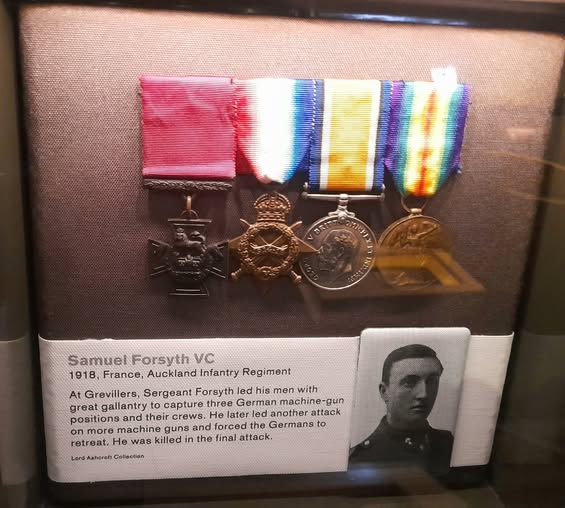
His VC was presented to his wife Mary by King George V at Buckingham Palace in November 1918. Following her death, and having never had children, Forsyth’s medals which included not only the VC, but also the 1914-15 Star, British War Medal, and the Victory Medal, were inherited by a nephew in Scotland.
They were sold at a Sotheby’s auction in November 1981 to Ken Downie, a dealer from Melbourne, Australia for £9,500. He resold them for $AUS17,500 on 26th January 1982. The medals were purchased by Lord Ashcroft in a private sale in 1992. They form part of the Ashcroft Collection which is being relocated to the National Army Museum, Chelsea.
LOCATION OF MEDAL: LORD ASHCROFT COLLECTION.
BURIAL PLACE: ADANAC MILITARY CEMETERY, FRANCE.
PLOT I, ROW 1, GRAVE 39




Acknowledgements:
Kevin Brazier -Cemetery Plan.
Thomas Stewart – Image of Medal Group at the Ashcroft Gallery