b. 15/09/1875 Dassel, Minnesota. d. 26/05/1930 Mexico.
DATE OF MOH ACTION: 13/05/1899 San Miguel de Mayumo, Philippines.
James Walter McIntyre was born on September 15, 1875, in Meeker County, Minnesota. Once he became of age, he served his country by enlisting in the First North Dakota Volunteer Infantry in May 1898.
That unit was formed to serve in the Philippines in the aftermath of the Spanish–American War, as Philippine insurgents opposed the U.S. military presence there. Intense battles occurred on the islands, particularly in 1899 and 1900.
Under the command of Civil War Medal of Honor recipient Gen. Henry S. Lawton, a group of about two dozen specialized soldiers were selected to serve as scouts. Assuming dangerous positions to assess enemy movements and plan for engagement, men like McIntyre were offered more than enough opportunities to prove their valor during the battles. McIntyre was soon selected to serve with Young’s Scouts, named after a civilian volunteer, and was involved in some of the most intense battles of the conflict, often significantly outnumbered and facing extreme danger. He was personally involved in two strategically significant battles in May 1899: the Battle of San Miguel on May 13 and the Battle at Tarbon Bridge near San Isidiro on May 16.
As a result of their bravery, Lawton recommended 20 soldiers for Medals of Honor for their actions in the two battles. McIntyre proved himself to be particularly exceptional by making Lawton’s Medal of Honor recommendation lists for not one, but both battles.
In the case of the Battle of San Miguel, Lawton wrote in his official report how the scouts “charged straight across the open for the right center of the enemy’s line, which wavered, broke, and, carrying with it the flanks, precipitously fled before the scouts could reach it.”
The battle saw only 12 scouts as an advance force successfully fight against 200–300 enemy soldiers. All 12, including McIntyre, were recommended for the Congressional Medal of Honor.
Just three days later, McIntyre and the other scouts faced down over 300 insurgents. In search of water, the scouts were attacked by enemy soldiers who set fire to a critical bridge, then hid in trenches as it burned. Not to be driven away so easily, “Under heavy fire the scouts charged across the bridge into the nearest trenches, routing the enemy,” Lawton wrote.
“While the greater number of the scouts were engaging the enemy in the trenches,” he wrote, “a few, recognizing the extreme importance of saving the bridge (a wooden structure) from burning, devoted all their energies to putting out the fire, and in doing so were exposed to the fire of the enemy until the latter were routed by their comrades.”
For his efforts, McIntyre made the general’s second list of 22 men to be recommended for the Medal of Honor. While approved by the president to receive the honor, the notification letter was sent to an outdated address in North Dakota and was never delivered to McIntyre. The War Department made no further efforts to deliver the award. Though McIntyre’s military service ended in 1900, his name appears at least three times in government records prior to his death in 1930, and after his 1906 Medal of Honor approval.
After moving to Chugwater in 1900, he took up farming and raised a family, marrying Inez May Boobar. They had twins named Harlan and Harriett in 1915, along with two other children. Tragedy struck, though, as his wife passed away in 1919. Sometime shortly thereafter, Harlan passed away in his youth.
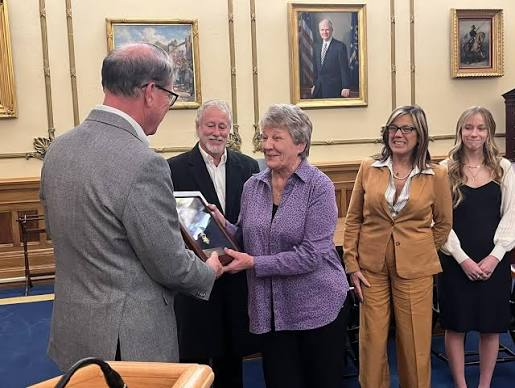
Harriett survived and would remain in Wyoming, marrying Clarence Kobel in 1935 and having three children, the oldest being Inez (Kobel) Lawson, who was recently awarded the medal as her grandfather’s oldest living relative. As McIntyre’s health worsened, he ended up living in a volunteers soldiers home in California from 1923 to 1925. By 1930, he had left Wyoming and was living in Columbus, New Mexico, where he started a freight and messenger service between Columbus and northern Mexico. However, two Mexican outlaws robbed and murdered him on May 26, 1930, during one of his business trips. He was shot five times at nearly point-blank range. He was buried where he was killed.
On January 16, 2025, after almost two years of petitioning, Eberhardt’s hard work paid off. McIntyre’s Medal of Honor was issued by the Department of Defense almost 119 years after it was approved. Lawson was informed of the award via an Army telephone notification, accidentally saying “My grandpa was a badass!” to a room full of people. “It was like he came alive,” she said. “He wasn’t just a name.”
A Medal of Honor “In Memory Of” headstone is present next to McIntyre’s wife’s grave in Iowa Flats Cemetery in Platte County.
MOH CITATION:
Private James W. McIntyre distinguished himself by acts of gallantry and intrepidity above and beyond the call of duty on May 13, 1899, while serving as a member of Company B, 1st North Dakota Infantry Volunteers at San Miguel de Mayumo, Luzon, Philippine Islands. On this occasion about 300 of the enemy were drawn up in line in an advantageous position requiring a frontal attack. Without waiting for the supporting battalion to reinforce them, or to get into a position to do so, Private McIntyre and 11 other Scouts charged the line of the enemy, about 150 yards distant, and completely routed them. Private McIntyre’s conspicuous gallantry, extraordinary heroism, and intrepidity at the risk of his life, above and beyond the call of duty, are in keeping with the highest traditions of military service and reflect great credit upon himself, his unit, and the United States Army.
BURIAL LOCATION: UNMARKED GRAVE IN MEXICO.
IMO HEADSTONE IN IOWA FLATTS CEMETERY, CHUGWATER, WYOMING.
LOCATION OF MEDAL: FAMILY.