b. 27/01/1897 Cheadle Hulme, Cheshire. d. 04/11/1918 Oise Canal, France.
James Kirk (1897-1918) was born on 27th January 1897 at Willow Bank, Ladybridge Road, Adswood, near Cheadle Hulme, Cheshire. His father, also James Kirk, was born in Little Lever, Lancashire. He married Rachel Simpson, in 1895, who was a linen weaver. James senior worked as a dyer’s traveller. They moved to Droylsden before the 1901 Census. James junior had three siblings – Jessie, Reginald and Donald (who died when he was just 5).

James Kirk VC
James was educated at Miss Chadwick’s School in Cheadle Hulme, then at Brentall Street School, Stockport before attending North Road United Methodist School in Clayton, Manchester. He was an apprentice blouse maker in 1911 and later a clerk at Ogden & Madeley’s Warehouse in Manchester. James was a keen sportsman, playing centre half for Seymour Old Boys’ Association Football Team, and was honorary secretary in the 1912-13 season, during which the team was unbeaten. He was also a member of Edge Lane CC.
James enlisted in 2/6th Manchester on 10th October 1914 and trained at Southport, Lancashire and Crowborough, Sussex. He went overseas on 2nd August 1915 and served at Gallipoli from 17th August, probably with 1/6th Battalion. He was promoted to lance corporal on 3rd November and was evacuated to Cairo with frostbite.
On his release from hospital in January 1916, he joined the Camel Transport Corps. This new unit was formed mainly from men who had served at Gallipoli. The Corps was divided into companies of which each had several officers and senior NCOs, together with a number of local men to actually drive the camels. Each company would have around 500 camels and would be used to carry stores across the desert. There are suggestions that he acted as his company’s quartermaster sergeant but, if he did, then he never got the proper rank to recognise it. A year later, he returned to the 1/6th and moved with the Battalion to France in March 1917. The summer saw quick promotion for James – first to Corporal on 16th July, then less than two weeks later to Acting Sergeant. This rank was made permanent on 11th August.
He was home for leave at Christmas and with a recommendation for a commission. He joined the 17th Officer Cadet Battalion at Kinmel Park in North Wales on 8th February 1918. In June 1918, he was gazetted as a 2nd Lieutenant in the 1/10th Battalion on 25th June. The Commander of the Cadet Battalion wrote in his file that James “was inclined to be slack but has improved a great deal lately. If he takes trouble with himself, he will make a fine officer.” James did not go overseas until October when he was attached to the 2nd Battalion, joining them on the 13th in France.
Just before 6am, on 4th November 1918, James was with two companies of the Battalion, and other troops, on the towpath of the Sambre-Oise canal, near the village of Ors in northern France. The Germans were entrenched on the opposite bank. The key to the success of the attack would be the ability of Royal Engineers units to construct rafts and pontoons that would allow the British troops to storm across. To cover the bridging of the canal he took a Lewis gun, and, under intense machine-gun fire, paddled across the canal on a raft, and at a range of ten yards expended all his ammunition. Further ammunition was paddled across to him and he continuously maintained a covering fire for the bridging party from a most exposed position till killed at his gun. The supreme contempt of danger and magnificent self-sacrifice displayed by this gallant officer prevented many casualties and enabled two platoons to cross the bridge before it was destroyed.
James had been wounded in the face and arm, before being shot through the head. He died instantly. James is buried alongside the poet Wilfred Owen MC who served with him in the 2nd Battalion and was also killed. Also nearby is the grave of James Neville Marshall VC. They were all buried in Ors Communal Cemetery, France. The parents of James Kirk were presented with their son’s posthumous Victoria Cross by King George V in the ballroom of Buckingham Palace on the 1st March 1919.
James is commemorated on the Tameside Metropolitan Borough Blue plaque in Edge Lane, Droylsden, on the blue plaque to all Tameside VCs at Ashton Town Hall in Manchester, named in the Book of Remembrance in Manchester Cathedral, on the Cheadle Hulme War Memorial, and with a VC commemorative stone placed at Cheadle Hulme War Memorial on 4th November 2018.
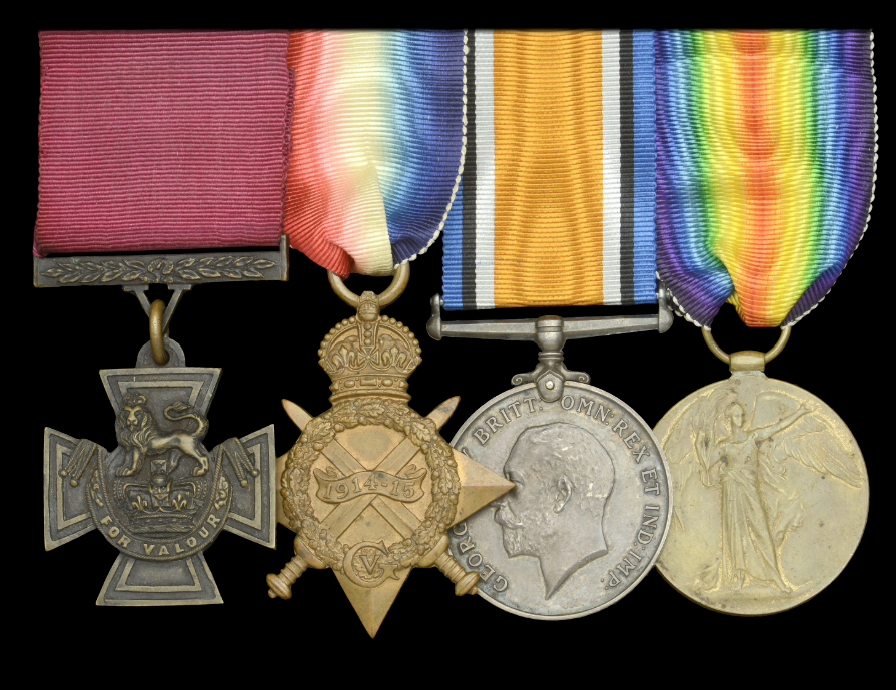
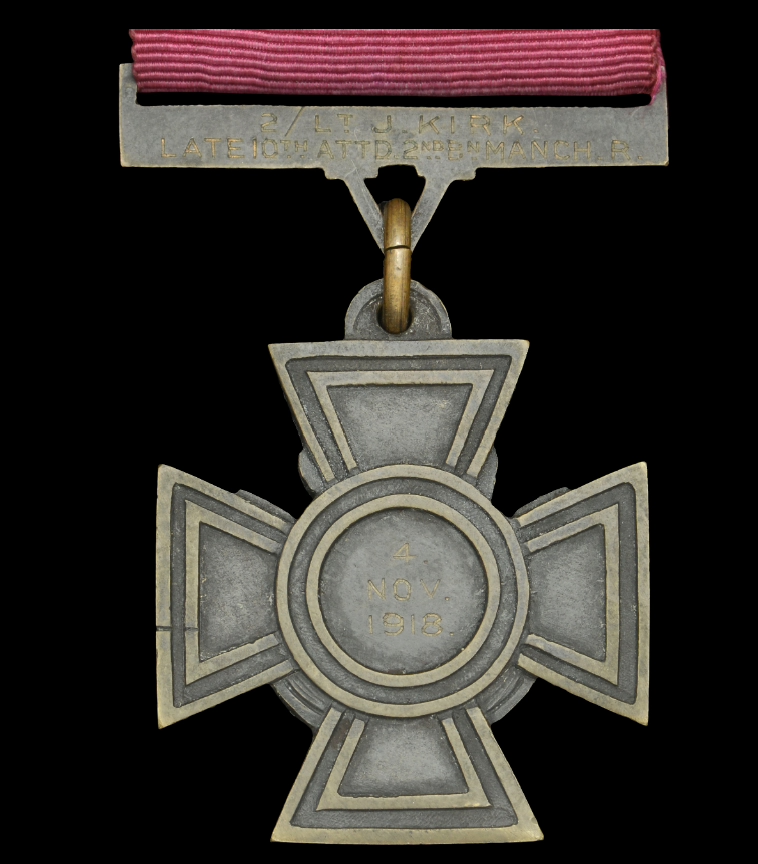
For a number of years the Victoria Cross awarded to Second Lieutenant James Kirk, 10th Bn, ( att’d 2nd Bn ), Manchester Regiment, had resided with the Military Medal Museum located in San Jose, California, USA. The museum contents were essentially a private collection which the owner was always willing to share with the general public.
Following the death of the owner several years ago the museum closed and the entire contents of medals and decorations placed in storage, where they have remained ever since. The owner’s widow is still alive but very elderly and her son has indicated there is no necessity to dispose of the medal collection in the foreseeable future. On 21st September 2026, it was announced that the James Kirk VC medal group was auctioned on 7th October 2026 at Noonan’s in Mayfair, London. The group realised a hammer price of £130,000.
LOCATION OF MEDAL: PRIVATELY HELD.
BURIAL PLACE: ORS COMMUNAL CEMETERY, ORS, FRANCE.
ROW A, GRAVE 31




Acknowledgements:
Paul Reed – Kirk VC Grave
Kevin Brazier – Cemetery Plan.
Derek Walker – Kirk VC name on Oldham War Memorial, Lancashire.
Noonan’s – Images of the James Kirk VC medal group and medal.