b. 09/07/1896 Clearwell, Gloucestershire. d. 08/11/1961 Lydney, Gloucestershire.
Francis George Miles (1896-1961) was born on 9th July 1896 at Clearwell, near Coleford, Gloucestershire. His father, Christopher George Miles, was born near Wooton Bassett (now Royal Wooton Bassett), Wiltshire, who lost both of his parents young. Christopher was a general labourer, living with his uncle, John Miles in Newland near Clearwell at the time of the 1891 Census. He married Annie Jane Perkins on 30th September 1895, registered at Monmouth, where she was born. By 1901 Christopher was a farm carter, living in East Dean, Gloucestershire under the employment of Alfred Dykins, a local auctioneer and tax collector. The marriage of Christopher and Annie is believed to have failed soon after Francis’ birth. Annie would remarry in 1905 to Fred Clack. Francis had seven half siblings.
By 1901, Francis was living with his maternal grandparents in Clearwell. He was educated at Clearwell Church of England School, near Coleford. By 1911 he was a farm labourer, living with her mother and stepfather at High Nash, Coleford, and was later employed as a miner by the Princess Royal Colliery Company at Bream. Whilst employed at the colliery he also attended evening classes run by Mr S Evans.
Francis enlisted with his stepfather, Fred Clack, in 9th Gloucestershire on 28th December 1914. He carried out training at Cheltenham, Gloucestershire and Fovant, near Salisbury, Wiltshire. On 20th September 1915 he went to France but suffered a poisoned foot. Whilst in hospital the battalion transferred to Salonika in November. On his release he was attached to 8th Gloucestershire (57th Brigade, 19th Division), and was attached to the Royal Engineers, where his skills as a miner were put to good use. He was wounded in the right thigh on 24th July 1917, possibly in a mine explosion. He was evacuated to Britain and was treated at St Luke’s Military Hospital, Halifax, Yorkshire. When he had recuperated, he was posted to 5th Gloucestershire (145th Brigade, 48th Division) in Italy in November, where he remained until August/September 1918, when the Battalion was sent to France to join 25th Division.

Francis G Miles VC
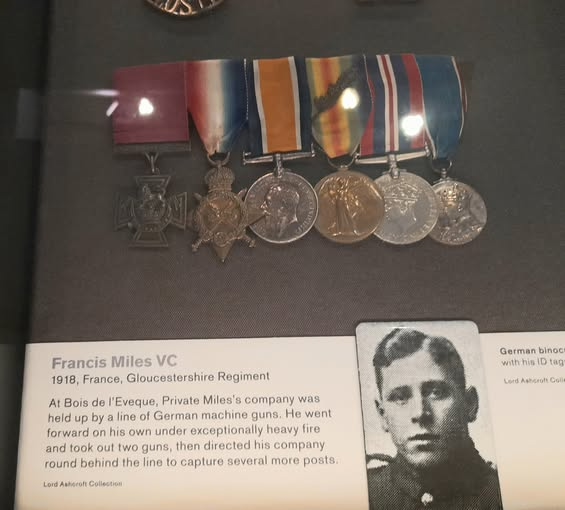
On 23rd October 1918 at Bois-l’Évêque, Landrecies, France, when his company was held up by a line of enemy machine-guns in a sunken road, Private Miles, alone and on his own initiative went forward under exceptionally heavy fire, located a machine-gun, shot the gunner and put the gun out of action. Then seeing another gun nearby, he again went forward alone, shot the gunner and captured the team of eight. Finally, he stood up and beckoned to his company who, acting on his signals, were able to capture 16 machine-guns, one officer and 50 other ranks.
He was gazetted for the VC on 3rd January 1919, and was invested with his Victoria Cross by King George V at Buckingham Palace on the 30th May 1919. He was the only other rank in the Gloucestershire Regiment to receive the VC. With the war behind him Private Miles returned to his home village of Clearwell to a Hero’s Welcome. The villagers presented him with a Gold Watch. He returned to working in the mines until November 1948, but suffered from ill health for the rest of his life.
He served with the Monmouthshire Regiment (Territorial Army) between December 1922 and December 1926 and with 8th (Home Defence) Battalion, Gloucestershire Regiment 1939-1940. He was then discharged as “permanently unfit for any form of military service”. Despite this he may have served thereafter in the 17th Gloucestershire (Wye Valley) Battalion, Home Guard, which was commanded by former Vice Admiral Alfred Carpenter VC, who was awarded the VC for his part in the Zeebrugge Raid in April 1918.
Francis attended a number of VC Reunions – the VC Garden Party at Buckingham Palace in June 1920, the Victory Day Celebration Dinner & Reception at The Dorchester in June 1946, and the VC Centenary Celebrations in Hyde Park in June 1956. Although he attended the latter event, he was reported missing from the parade when the Queen arrived. Two Guardsmen later found him in a local public house. On 23rd September 1953, Francis was declared as 100% disabled, suffering from deafness, emphysema and arteriosclerosis.
Francis George Miles V.C. died in Lydney & District Hospital, Gloucestershire on 8th November 1961 aged 65. He was buried in St Peter’s Churchyard, Clearwell. In 2003 members of the Royal Gloucestershire, Berkshire and Wiltshire Regimental Association gathered to pay tribute to Private Francis Miles VC, buried in his home village of Clearwell, Gloucestershire. The Association was disturbed to discover the deteriorating condition of his grave and headstone, so decided, with the family’s permission, to commission a new stone. On the 23rd May 2004, a new headstone was dedicated to Francis Miles VC in St Peter’s Churchyard. He is commemorated with a memorial plaque on the house he was born in Clearwell, with a memorial plaque in St Peter’s Church, and with a VC commemorative stone placed at Clearwell Church Cemetery on 23rd October 2018. There is also an armoury block at Catterick Camp in North Yorkshire named after him.
In addition to his VC, he was awarded the 1914-15 Star, British War Medal 1914-20, Victory Medal 1914-19 with Mentioned in Despatches oakleaf, War Medal 1939-45 and George VI Coronation Medal 1937. He was entitled to the Elizabeth II Coronation Medal 1953 but it is not in his medal group. There is a MiD Oakleaf on the Victory Medal but no entry has been found in the London Gazette. His medals were sold for £72,000 to Lord Ashcroft at Morton & Eden on 25th May 2005. The medals are held in the Ashcroft Collection, currently relocating to the National Army Museum in Chelsea.
LOCATION OF MEDAL: LORD ASHCROFT COLLECTION.
BURIAL PLACE: ST PETER’S CHURCHYARD, CLEARWELL, GLOUCESTERSHIRE.