b. 25/10/1891 New Ross, County Wexford, Ireland. d. 20/11/1940 Dublin, Ireland.
Martin Doyle (1891-1940) was born on 25th October 1891 at Cloonagh, Gusserane, New Ross, County Wexford, Ireland. Hia father, Laurence “Larry” Doyle, was a labourer from Ballycullane, County Wexford. He married Bridget Fardy on 28th November 1882 at Ballycullane. Martin had six sisters.
Very little is known about his early life. He was educated at Gusserane National School and Cushinstown School, both in New Ross, County Wexford. He was employed as a farm worker after schooling. On 12th March 1909 he enlisted in 4th Royal Irish Regiment, Special Reserve at Waterford, and joined at Kilkenny. He added four months to his age. He transferred to the Regular Army on 28th December 1909, served in India with the 1st Battalion and became the Battalion lightweight boxing champion in 1913. He returned to Ireland in 1914, transferred to the Royal Dublin Fusiliers and went to France on 19th December 1914. He was promoted to sergeant in 1915 and transferred to 1st Royal Munster Fusiliers on March 1918.
On 27th March 1918 he was awarded the Military Medal for his actions when the Battalion was in reserve during an attack. The troops in front were driven back and the Battalion counterattacked. Harbonnieres and Vauvillers were taken and over 900m of open ground was crossed with heavy casualties. The enemy trench was reached but another trench forty metres on was still held. Between was a barn in which the enemy positioned a machine gun. Doyle called for volunteers and charged. He reached the barn alone, bayoneted the two Germans and took the machine gun. He was captured by the Germans later in the March retreat and was treated badly but escaped during a counterattack.

Martin Doyle VC MM
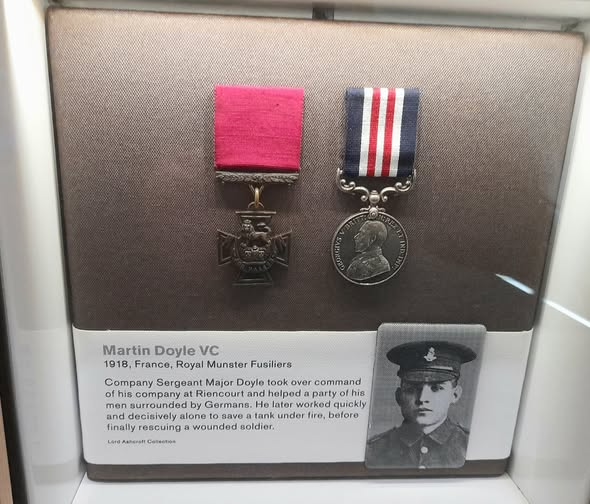
On September 2nd, 1918, at Riencourt in France, Doyle demonstrated the “conspicuous bravery” for which he would be awarded the Victoria Cross. All senior officers being wounded, command had fallen to Doyle, who extricated a party of his men who were surrounded by the enemy, and carried back, under heavy fire, a wounded officer. Later he went forward under intense fire to the assistance of a tank and when an enemy machine-gun opened fire, he captured it single-handedly and took three prisoners. He repelled a counter-attack, taking many more prisoners.
The official announcement concluded: “Throughout the whole of these operations, Doyle set the very highest example to all ranks by his courage and total disregard of danger.”
When the awarding of his VC was confirmed, he wrote to his parents: “I am all in a whirl of joy.”
Doyle was welcomed home to New Ross in March 1919 by a large crowd. The local newspaper reported: “The meeting between the young hero and his aged parents was very touching: going straight to his mother and father he embraced them. He was escorted to his home in Mary Street amidst a scene of great enthusiasm. As they approached the Royal Hotel a trumpeter standing on the steps sounded a stirring bugle call which evoked ringing cheers. There was a profusion of decorations in the town along with scrolls bearing words of welcome to the New Ross hero.”
He went to Buckingham Palace to receive his VC from the King on 8th May 1919, but left the army that July. He married Charlotte Mary Kennedy of New Ross, on 25th November 1919 in Dublin. She was living with her aunt previously. They had four children – Bridget, Laurence, Maria and Charlotte.
He became a member of the Royal Munster Fusiliers Old Comrades Association shortly after his discharge. However, whilst working for the British Army at Ennis, he was recruited as an intelligence officer for the IRA with the Mid Clare Brigade, during the War of Independence 1920-21. Ironically, he was a member of the IRA when he attended the VC Garden Party at Buckingham Palace on 26th June 1920. He was also in the VC Guard at the interment of the Unknown Warrior on 11th November 1920. He also attended the VC Dinner at the House of Lords on 9th November 1929.
Martin enlisted in the Irish Free State Army in February 1922 and fought in the Civil War. He served in Waterford, Kilkenny and South Tipperary and was wounded in the left arm in early 1923. He continued to serve in 2nd and 20th Infantry Battalions and at the School of Instruction before retiring from the Army in 1938 as a sergeant major. He was on the strength of 2nd Battalion Reserve Regiment until 25th January 1939. He then worked as a security guard for Guinness.
Martin developed pneumonia and was admitted to Sir Patrick Dun’s Hospital, Dublin, where he died on 20th November 1940. He was buried in Grangegorman Cemetery, near McKee Barracks, Cabro, Dublin. The grave was paid for by the Old Comrades’ Association and his widow. His headstone bears the badge of the Royal Munster Fusiliers. He is commemorated with a VC commemorative stone unveiled at Glasnevin Cemetery, Dublin on 11th November 2018, on the Irish VC Memorial at the National Memorial Arboretum, Alrewas, and with a blue plaque on his former home in New Ross.
In addition to his VC and MM, he was awarded the 1914-15 Star, British War Medal 1914-20, Victory Medal 1914-19 and George VI Coronation Medal 1937. The VC was offered for sale at Sotheby’s on 1st March 1984 but was withdrawn at the last minute. It was auctioned by Spink’s on 7th November 1995 and was purchased for £19,000 by Lord Ashcroft. The medals are now in process of being transferred to the National Army Museum in Chelsea.
LOCATION OF MEDAL: LORD ASHCROFT COLLECTION.
BURIAL PLACE: GRANGEGORMAN MILITARY CEMETERY, DUBLIN, IRELAND.