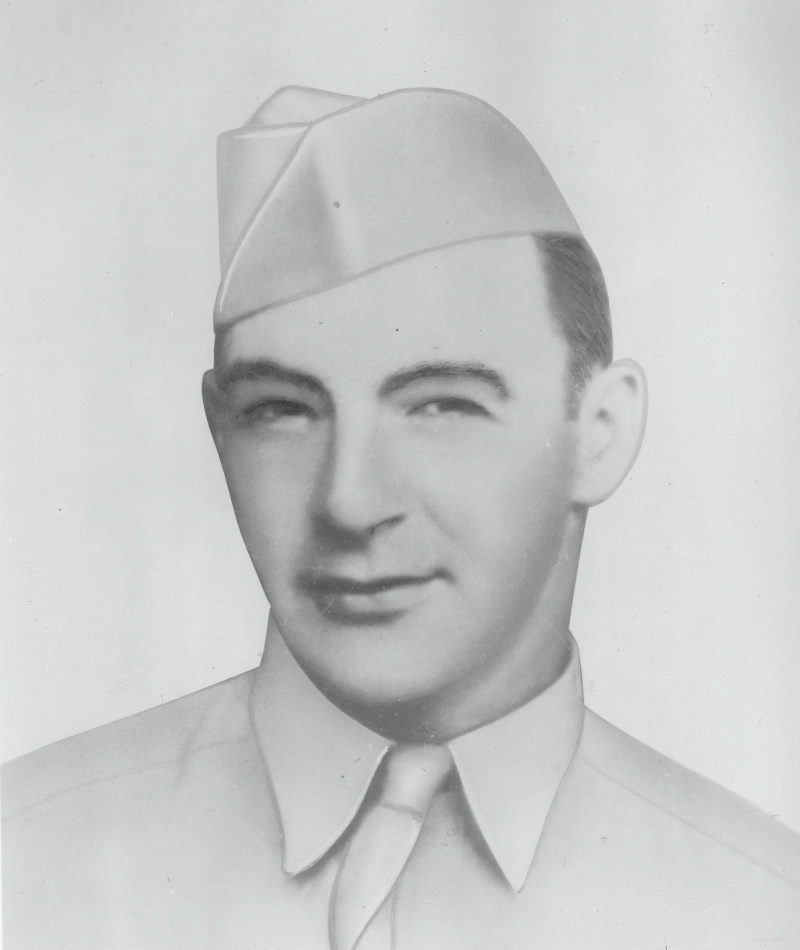
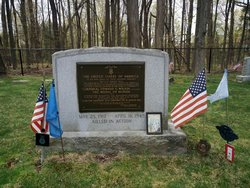
b. 25/05/1917 Burlington, Vermont. d. 18/04/1945 Germany.
DATE OF MOH ACTION: 18/03/1945 Siegfried Line, Germany.
Edward G Wilkin MOH
Edward Wilkin was born in Burlington Vermont on March 25, 1917. The family moved to Springfield, MA after 1920 and Edward eventually resided on Bellevue Avenue in Longmeadow. He married Hazel Brayton in 1938 and had a son, Robert Jesse, in 1941. Edward worked for Adaskin Furniture and Pratt and Whitney before entering the Army in December 1943.
Wilkin earned the Combat Infantry Badge for exemplary action against the enemy on January 18, 1945. For his actions on March 18 1945 on the Siegfried Line in Germany, Corporal Wilkin was awarded the Medal of Honor. This medal is the highest and most prestigious military honor given for “Intrepidity. Above and beyond the call of duty. Risk of life. Selflessness. Exemplary action. Unwavering devotion. Conspicuous gallantry. Extraordinary heroism”
Unfortunately, Corporal Wilkin was killed by a German sniper on April 18, 1945. The war in Europe ended on May 8, 1945. Nearly six hundred Longmeadow men and women served in the armed forces during World War II. For actions during World War II, 472 United States military personnel received the Medal of Honor. Twenty-two Medals of Honor were awarded to men connected to Massachusetts: thirteen serving in the Army, seven in the Marine Corps, and two in the Navy.
The Medal of Honor was presented to Corporal Wilkin’s son posthumously in January 1946.
MOH CITATION:
He spearheaded his unit’s assault of the Siegfried line in Germany. Heavy fire from enemy riflemen and camouflaged pillboxes had pinned down his comrades when he moved forward on his own initiative to reconnoiter a route of advance. He cleared the way into an area studded with pillboxes, where he repeatedly stood up and walked into vicious enemy fire, storming one fortification after another with automatic rifle fire and grenades, killing enemy troops, taking prisoners as the enemy defense became confused, and encouraging his comrades by his heroic example. When halted by heavy barbed wire entanglements, he secured bangalore torpedoes and blasted a path toward still more pillboxes, all the time braving bursting grenades and mortar shells and direct rifle and automatic-weapon fire. He engaged in fierce firefights, standing in the open while his adversaries fought from the protection of concrete emplacements, and on one occasion pursued enemy soldiers across an open field and through interlocking trenches, disregarding the crossfire from two pillboxes until he had penetrated the formidable line 200 yards in advance of any American element. That night, although terribly fatigued, he refused to rest and insisted on distributing rations and supplies to his comrades. Hearing that a nearby company was suffering heavy casualties, he secured permission to guide litter bearers and assist them in evacuating the wounded. All that night he remained in the battle area on his mercy missions, and for the following two days he continued to remove casualties, venturing into enemy-held territory, scorning cover, and braving devastating mortar and artillery bombardments. In three days he neutralized and captured six pillboxes singlehandedly, killed at least nine Germans, wounded 13, took 13 prisoners, aided in the capture of 14 others, and saved many American lives by his fearless performance as a litter bearer. Through his superb fighting skill, dauntless courage, and gallant, inspiring actions, Cpl. Wilkin contributed in large measure to his company’s success in cracking the Siegfried line. One month later he was killed in action while fighting deep in Germany.
BURIAL LOCATION: LONGMEADOW CEMETERY, LONGMEADOW, MASSACHUSETTS.
DIVISION 2, RANGE 4, LOT 8.
LOCATION OF MEDAL: LONGMEADOW HISTORICAL SOCIETY, LONGMEADOW, MASSACHUSETTS.