b. 04/04/1925 Wilmot, South Dakota.
DATE OF MOH ACTION: 18/11/1952 near Hoeryong, Korea.

Elmer R Williams MOH
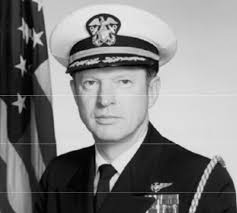
Royce Williams grew up in Wilmot, South Dakota. He and his brother both aspired to fly, and both enlisted after the 1941 Pearl Harbour attack. Williams remained in the Navy while attending college in Minnesota, and qualified as a naval aviator at Pensacola in August 1945. He learned to fly the F9F-5 Panther jet and was assigned to active duty in the Korean War, where he flew 70 missions.
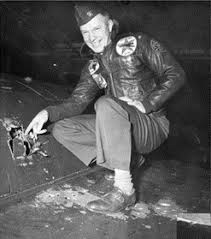
In 1952, then-Lieutenant Williams was serving with VF-781 aboard the USS Oriskany as part of Task Force 77. On 18 November 1952, on his second mission of the day, while on combat air patrol near Hoeryong, North Korea, his group of four pilots spotted seven MiG-15s overhead. The other three pilots had to return to the carrier and the MiGs began to fire on Williams, putting him into a one-man dogfight with seven MiG-15s that lasted 35 minutes. It is believed to be the longest dogfight in U.S. Navy history. Commanders on his carrier ordered him away, but Williams had to tell them that he was already fighting for his life. He shot down four of the MiGs and likely hit two others. By the end of the 35-minute period, only one of the MiGs was still in the air with him, and he managed to escape back to his carrier, out of ammunition and having lost his hydraulics. He was uninjured, but 263 holes were counted in his Panther jet. While reported by others that he never saw the plane again as it was pushed into the sea, aircraft logs for BuNo 125459 show the aircraft flew until 1959 and was stricken on May 31 while attached to NAS Kingsville.
The story of his battle with the Soviet-piloted MiGs led to Williams being debriefed at the time by admirals, the Secretary of Defense, and a few weeks later by newly inaugurated President Dwight D. Eisenhower. These authorities made a decision to cover up the specifics of the battle, because at that time the Soviet Union was not officially a combatant in the Korean War and it was feared that publicity about the air battle would draw the Soviets further into the conflict. The dogfight was scrubbed from U.S. Navy and National Security Agency records, and Williams was sworn to secrecy about the incident—so much so that he never told anyone about it, not even his wife nor his pilot brother, until the Korean War records were declassified in 2002. The record of the incident in Navy records said only that he shot down one enemy (not listed as “Soviet”) plane and damaged another, for which he was awarded the Silver Star in 1953. However, the dogfight was recorded in Soviet archives which were released after the fall of the Soviet Union in the 1990s. The Soviet records confirmed that of the seven MiGs, only one returned to its base. A 2014 Russian book, Red Devils over the Yalu: A Chronicle of Soviet Aerial Operations in the Korean War 1950–53, reported the battle and named Williams. The four MiGs were flown by Soviet Naval Aviation pilots, with Captains Belyakov and Vandalov, and Lieutenants Pakhomkin and Tarshinov being shot down. In his book Holding the Line about Task Force 77, Thomas McKelvey Cleaver described the fight, saying “On November 18, 1952, Royce Williams became the top-scoring carrier-based naval aviator and the top-scoring naval aviator in a Navy jet of the ‘forgotten war’.” He added, “In the fight of his life, Royce Williams had accomplished what no other American fighter pilot would ever accomplish: shoot down four MiG-15s in one fight.”
Between 1965 and 1967, he flew 110 missions in A-4 Skyhawks and F-4 Phantoms from the aircraft carrier USS Kitty Hawk during the Vietnam War. Williams was the commanding officer of the command ship USS Eldorado between September 1969 and January 1971. He retired from the Navy as a captain in 1980. In retirement, he lives in Escondido, California.
There has been a years-long campaign to award Williams the Medal of Honor for his exploit. In 2014, retired Rear Admiral Doniphan Shelton became aware of Williams’s feat, and he tried unsuccessfully for years to get the Navy or Department of Defense to recommend him for the medal. He said that Williams’s heroism was “unmatched either in the Korean War, the Vietnam War, or since then”. On 14 July 2022, a bipartisan group of five congressmembers persuaded the House of Representatives to approve an amendment to the Defense Authorization Act which would waive the statute of limitations for a potential Medal of Honor for Williams. The amendment and bill were approved for the House version of the bill, which were then forwarded to the United States Senate, which removed the provision in conference. In 2021, one veteran who helped Shelton with his quest believed that there was still only a 75 percent chance of the medal being awarded; the key problem is that the dogfight is not recorded in official U.S. records.
In December 2022 Williams was awarded the Navy Cross as an upgrade of the Silver Star the Navy awarded him in 1953. The award was approved by U.S. Secretary of the Navy Carlos Del Toro, who said, “Having reviewed the findings of now numerous investigations related to the case of Capt. Royce Williams, I have determined this case to be special and extraordinary. His actions clearly distinguished himself during a high-risk mission and deserve proper recognition.”
On February 4, 2026, Williams’s congressman Darrell Issa announced confirmation from President Donald Trump that Williams would be receiving the Congressional Medal of Honor. Williams received his Medal of Honor during the State of the Union address by President Donald J. Trump at the US Capitol on February 24, 2026. The First Lady, Melania Trump, presented him with the Medal.
MOH CITATION:
For conspicuous gallantry and intrepidity at the risk of his life above and beyond the call of duty on 18 November 1952 while leading a division of three jet fighters attached to Fighter Squadron SEVEN HUNDRED EIGHTY-ONE (VF-781) and embarked on the USS ORISKANY. While flying a combat patrol mission over the northeastern coastal waters of enemy-held North Korea, Lieutenant Williams demonstrated extraordinary heroism by intercepting a superior force of attacking enemy MiG-15 fighters in order to protect the ships of Task Force 77. After thwarting the enemy’s initial attack, he maneuvered his aircraft to make two firing passes on one MiG, which then spiraled into the sea. He inflicted heavy damage to a second MiG-15, which started smoking badly and retired from the fight. When his own aircraft was severely damaged by a direct hit from one of the remaining enemy MiG-15s, Lieutenant WIlliams evaded further enemy attack while continuing to direct the dogfight. He eventually found cover in a cloud bank, broke off the engagement, and miraculously landed his nearly uncontrollable aircraft on the USS ORISKANY. His exceptional airmanship, coupled with his complete disregard for his own personal safety, resulted in the destruction of three enemy MiG-15s and severe damage to a fourth, and undoubtedly saved the lives of hundreds of Task Force 77 sailors. By his undaunted courage, bold initiative, and total devotion to duty, Lieutenant Williams reflected great credit upon himself and upheld the highest traditions of the United States Naval Service.
LOCATION OF MEDAL: WITH RECIPIENT.