b. 02/10/1895 Shotton, Flintshire, Wales. d. 13/01/1959 Rhyl, Wales.
Henry “Harry” Weale (1895-1959) was born on 2nd October 1895 at Nine Houses, Brook Road, Shotton, Flintshire, Wales. His father, John, was born in Much Wenlock, Shropshire, and was a general labourer in 1891. John married Sarah Hughes in 1893 in Chester. By 1911, John was a dock labourer. Harry had seven siblings – John, Frank, Frederick, William, Gilbert, Norman and Harriet (born and died 1909).
Harry was educated at St Ethelwold’s School, Shotton, Flintshire. He was a general labourer in 1911 and also worked as a packer at John Summer’s Steelworks in Shotton. He enlisted in 5th Royal Welsh Fusiliers on 1st November 1911 and was discharged to 3rd (Special Reserve) Battalion on 8th September 1913.
Harry was mobilised on 5th August 1914 and embarked for France on 1st November. He was wounded and evacuated to Britain on 10th December, returning to France on 16th March 1915. He was wounded again on 1st October and was evacuated to Britain, returning to France on 14th September 1916. He was gassed on 16th January 1917 and was evacuated to Britain, returning to France on 22nd August. He was promoted to lance corporal on 8th December.

Henry Weale VC
On 26th August 1918 at Bazentin-le-Grand, France, when the advance of the adjacent battalion was held up by enemy machine-guns, Lance-Corporal Weale was ordered to deal with hostile posts. When his Lewis gun failed him, on his own initiative, he rushed the nearest post and killed the crew, then went for the others, the crews of which fled on his approach. His dashing action cleared the way for the advance, inspired his comrades and resulted in the capture of all the machine-guns.
He returned home to Shotton where he stepped off the train to a hero’s welcome from crowds who had gathered from miles around. He was presented with an illuminated address by the headteacher of his former primary school, St Ethelwold’s. It read: “The parish is proud to know that one of its own boys has won, by deed of valour, the highest distinction which a British soldier can win.”
He received his VC from King George V at Buckingham Palace on 1st March 1919. Bosses at John Summers were so impressed with Harry’s bravery, they presented him with a gold hunter pocket watch. Harry married Susie Harrison of Rhyl on 16th June 1919, where the couple moved to. They would have seven children. However, it was then things began to change for Harry. Conditions were dreadfully hard for men returning from war. Britain was meant to be a land fit for heroes, but when many returned, many like Harry Weale found themselves on the scrapheap.
Harry went from a hero, invited to receptions at Buckingham Palace, to a poorly-paid council worker. Susie’s mother was in poor health and Harry was forced to sell his John Summers gold watch. Perhaps one of the most touching tales of Harry’s life was that his former employer John Summers tracked down and bought the gold watch he was forced to part with. The firm returned the timepiece to his nephew in the 60s, and it remains with the family to this day.
He attended a number of VC reunions – the VC Garden Party at Buckingham Palace on 26th June 1920, the VC Dinner at the House of Lords in November 1929, the Victory Day Celebrations at The Dorchester in June 1946 and the VC Centenary Celebrations in Hyde Park in June 1956. He re-enlisted in the Royal Welsh Fusilierson 7th February 1921 and served in Ireland. He was promoted sergeant and was discharged in February 1922.
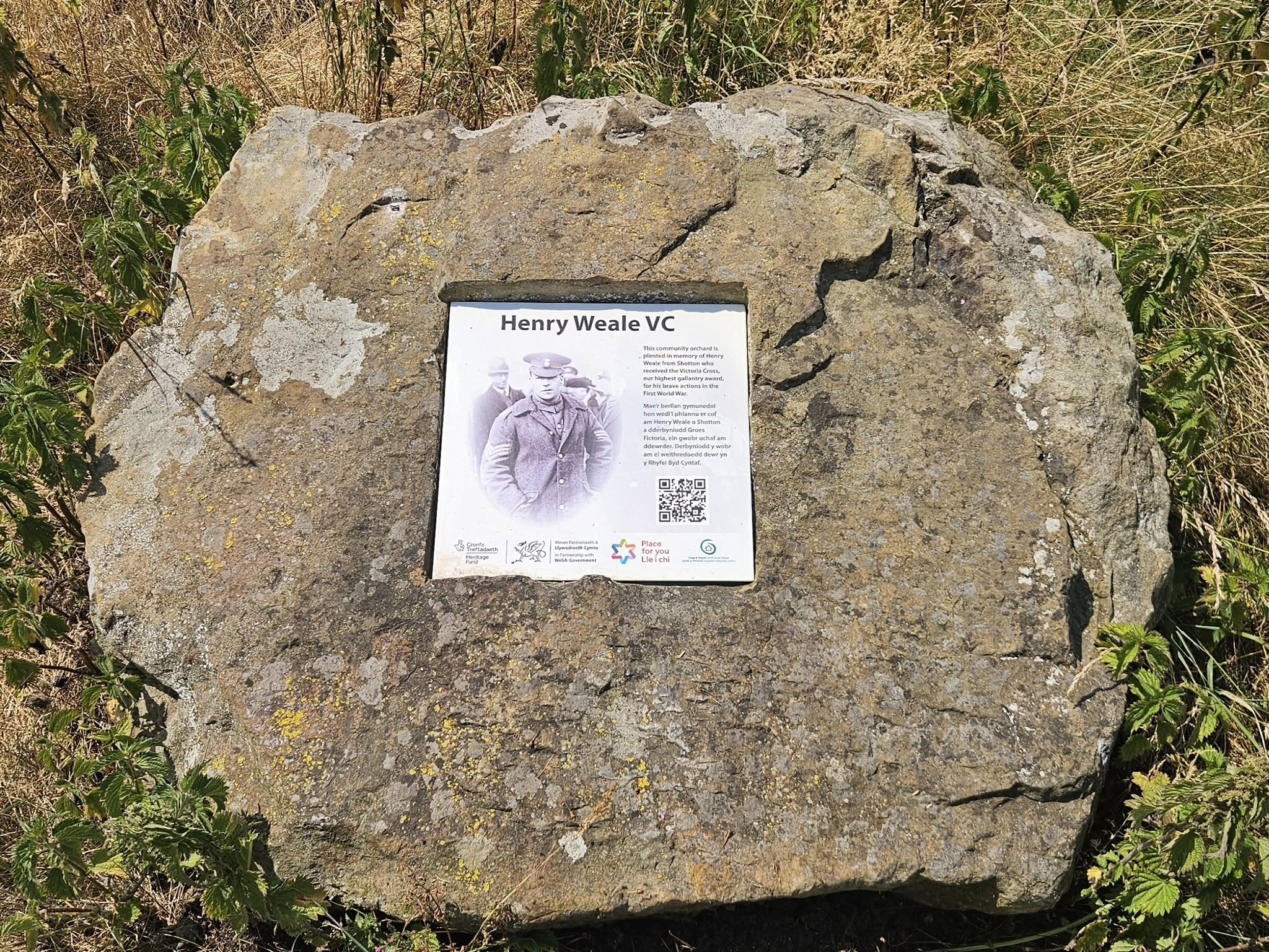
Harry died on 13th January 1959 in Rhyl at the age of 64, and he was buried with full military honours at Rhyl Cemetery. He is commemorated with Weale Court in Wrexham, Wales, Harry Weale Hall in Queensferry, Clwyd, with the Harry Weale VC Memorial Garden in Shotton, Flintshire, and a VC commemorative stone placed in Brook Road, Shotton on 11th November 2018.
His medals including the VC, 1914-15 Star, British War Medal 1914-20, Victory Medal 1914-19 with Mentioned in Despatches oakleaf, Defence Medal 1939-45, War Medal 1939-45, King George VI Coronation Medal 1937 and Queen Elizabeth II Coronation Medal 1953. The medals are held by the Royal Welch Fusiliers Museum, Caernarfon Castle.
LOCATION OF MEDAL: ROYAL WELCH FUSILIERS MUSEUM, CAERNARFON, WALES.
BURIAL PLACE: RHYL CEMETERY, RHYL, WALES.
SECTION 10, GRAVE 4829.


Acknowledgements:
Kevin Brazier – Cemetery Map.
Thomas Stewart – Image of the Weale VC Medal Group at the Royal Welsh Fusiliers Museum, Caernarfon.
Bill Rosedale – Images of the two VC Stones at Shotton, Flintshire, and in Connah’s Quay, Wales, and the Memorial plaque in Dee Park, Shotton.