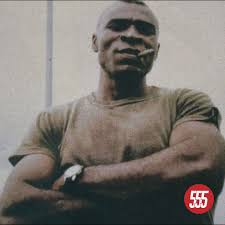
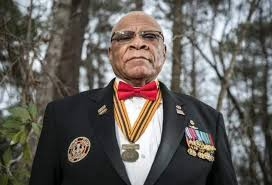
b. 25/08/1939 Bishopville, South Carolina.
DATE OF MOH ACTION: 31/03 – 04/04/1967 Phu Loc, Vietnam.
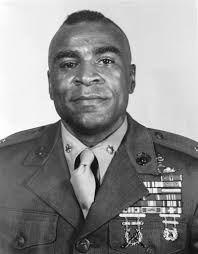
James J Capers MOH
Born in Bishopville, South Carolina in 1939, he rose from humble beginnings in the segregated South to become one of the most decorated Reconnaissance Marines in history. His family were sharecroppers. He later moved to Baltimore where he would meet the love of his life and future wife Dottie and decide to enlist in the Marines. This would be the start of a legendary career that overcame obstacles and broke barriers on and off the battlefield as one of the greatest Marines to ever serve.
While serving, he would be selected to join the elite Force Recon Marine unit where he excelled, breaking training records, participating in 64 long range reconnaissance patrols and five major campaigns in Vietnam. He was a natural leader and father figure to Team Broadminded, a specialized group of Force Recon Marines. Capers & Team Broadminded were routinely selected to go on the most dangerous and clandestine missions in Vietnam.
Force Recon Marines carried out some of the most dangerous missions of the Vietnam War. Operating in small teams with limited support, they relied on stealth, skill, and extraordinary discipline. Discovery by enemy forces often meant being vastly outnumbered and fighting for survival until their extraction could be arranged.
During the mission near Phu Loc, Team Broadminded was ambushed by a large enemy force. The ambush triggered a fierce firefight that quickly turned into a desperate struggle. Capers was struck repeatedly by shrapnel and gunfire. By the end of the engagement, he had sustained 17 wounds, among them was a broken leg. But he refused to relinquish command.
Despite his injuries, Capers continued to direct the defense and coordinate support. He called in artillery fire, organized the movement of his Marines, and maintained control of the situation even as his physical condition deteriorated. At one point, as a helicopter attempted to extract the wounded, it struggled to gain altitude under the weight of those aboard. Capers reportedly tried to sacrifice himself by leaving the aircraft to ensure the others could escape. His Marines and the crew refused to leave him behind.
Only after every member of his team had been safely evacuated did Capers allow himself to be treated. All of the Marines survived. The story of the mission became legendary within the Force Recon community and across the Marine Corps. For those who served with him, it was a defining example of leadership under fire.
In the aftermath of the battle, Maj. Gen. Bruno Hochmuth, commanding general of the 3rd Marine Division, intended to recommend Capers for the Medal of Honor. He reportedly interviewed the members of Team Broadminded and concluded that Capers’ actions met the criteria for the nation’s highest award for valor.
Before the recommendation could be completed and submitted, however, Hochmuth was killed in a helicopter crash. With his death, the process stalled. In the chaos of war and the complexity of military bureaucracy, the recommendation was never finalized. Over time, the absence of completed paperwork and missed deadlines complicated efforts to revisit the case.
Capers initially received a Bronze Star with “V” for valor. Decades later, after renewed advocacy and review, the award was upgraded to the Silver Star in 2010. While significant, many Marines and historians believe the Silver Star does not fully capture the magnitude of his actions during the 1967 mission. He became the first Black enlisted Marine to receive a battlefield commission to officer rank, a rare honor reflecting extraordinary leadership in combat. He later became the first Black Marine to command a Force Reconnaissance company, leading one of the Corps’ most elite units.
In the fall of 1967, still recovering from combat injuries, Major James Capers was selected to represent the U.S. Marines in a national recruiting campaign. With full integration completed only in 1960, Capers’ image became the Marine Corps most popular recruitment campaign. Following Vietnam, Capers participated in many Cold War covert operations as a field agent in Eastern Europe and Africa. Details of these operations remain classified today.
His wife Dottie and son Gary passed away in 2003 and were buried in Arlington National Cemetery. Capers celebrated his 50th anniversary with Dottie one week before her passing. On February 3, 2026, the House of Representatives passed H.R. 3377, legislation introduced by Rep. Ralph Norman of South Carolina. The bill authorizes President Trump to award the Medal of Honor to Capers by waiving the statutory time limit that normally governs such decorations. A month later, the Senate approved the measure and sent it to President Trump for signature into law.
In April 2026, it was announced that President Donald J. Trump had called Major James J Capers to inform him of the award of the Medal of Honor. On June 6, 2026, Capers was presented with his Medal of Honor at the White House from President Donald J. Trump.
MOH CITATION:
The President of the United States of America takes pleasure in presenting the Silver Star to Major (then Second Lieutenant] James Capers, Jr. (MCSN: 0-95892), United States Marine Corps, for conspicuous gallantry and intrepidity in action against the enemy as Team Leader and Platoon Commander, First Platoon, Forward Detachment, Third Force Reconnaissance Company, Third Reconnaissance Battalion, THIRD Marine Division, during combat operations in the vicinity of Phu Loc, Republic of Vietnam from 31 March to 3 April 1967. Beginning a four day long foot mobile reconnaissance patrol, Major Capers maneuvered his team through rugged enemy territory. His team was tasked to locate a suspected North Vietnamese regimental base camp southwest of Phu Loc and provide observation for the flank of Company M, Third Battalion, Twenty-Sixth Marines. The area proved to be heavily inhabited by the enemy as Major Capers’ team made contact with twenty enemy soldiers on their first day of patrolling, with two additional contacts the following day, resulting in one severely wounded Marine. Despite the threat posed by the numerically superior enemy force, Major Capers maintained pursuit of a vigilant and tenacious adversary. He called for fire on an enemy base camp, thus thwarting an impending attack on the Marine battalion. On the last day of the patrol, Major Capers’ nine man patrol was again engaged by a numerically superior enemy force with an initial attack from a daisy-chained claymore mine. Within moments Major Capers sustained multiple fragmentation and bullet wounds from dense barrages of direct and indirect enemy fire. Ignoring the severity of his wounds and an extreme loss of blood, he maintained the initiative and continued the fight with his team. Despite being administered morphine for his severe wounds, he continued to coordinate supporting fire and the team’s movement to the helicopter extraction site. While struggling to maintain consciousness and still under attack, Major Capers demanded continuous situation and status reports from his Marines and ensured the entire team was evacuated before himself. Barely able to stand, Major Capers finally boarded the helicopter and was evacuated. By his bold leadership, undaunted courage, and complete dedication to duty, Major Capers reflected great credit upon himself and upheld the highest traditions of the Marine Corps and of the United States Naval Service.
LOCATION OF MEDAL: WITH RECIPIENT.