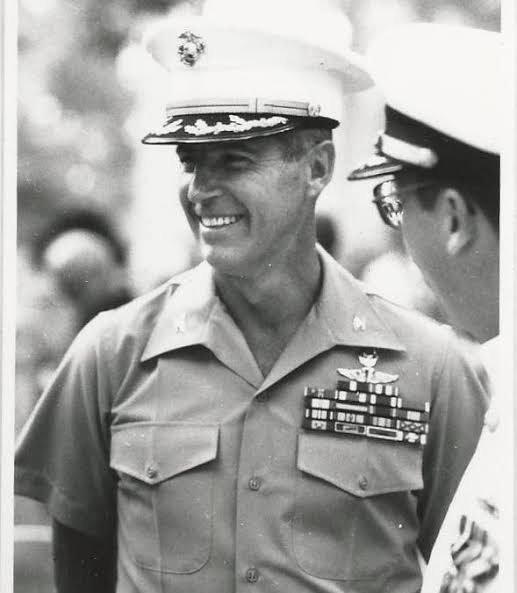
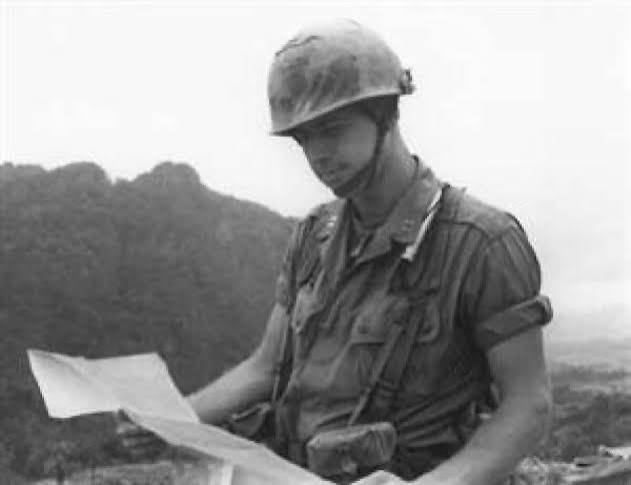
b. 29/06/1939 Radford, Virginia. d. 28/10/2008 Annapolis, Maryland.
DATE OF MOH ACTION: 02/04/1972 Dong Ha, Vietnam.

John W Ripley MOH
John Walter Ripley was born on June 29, 1939, in Radford, Virginia and his family lived there until he was five years old. They then moved to Portsmouth, Ohio, where they remained for some years before finally settling in Radford, Virginia. After graduating from Radford High School, Ripley enlisted into the Marine Corps in 1957 at age 17. A year later, he was appointed to the U.S. Naval Academy by the Secretary of the Navy. He graduated in 1962 with a Bachelor of Science degree in electrical engineering, and received his commission as a second lieutenant. After completing The Basic School, he joined the Marine detachment on the USS Independence. After his sea duty, he joined 2nd Battalion, 2nd Marines. In May 1965, Ripley was transferred to 2nd Force Reconnaissance Company, and after training, he deployed to South Vietnam with his platoon.
In October 1966, Ripley joined 3rd Battalion 3rd Marines in South Vietnam. He served as company commander of Lima Company, known as Ripley’s Raiders, was wounded in action, then returned to active duty and completed his combat tour. In October 1969, he was selected to serve as exchange officer with the British Royal Marines and Special Boat Service.
During his two years of Vietnam service, he participated in 26 major operations. In addition to numerous decorations for extensive combat experience at the rifle company and battalion levels, Ripley was awarded the Navy Cross for extraordinary heroism in destroying the Dong Ha bridge during the April 1972 North Vietnamese Easter Offensive (also known as the Nguyen Hue Offensive). That action is memorialized at the U.S. Naval Academy with a large diorama titled “Ripley at the Bridge.”
Following his tours in Vietnam, he was promoted to major on 1 June 1972. Ripley served with Marine Force Reconnaissance; served as the military aide to General Snowden and Chief of Staff of the Marine Corps during the late 1970s. As a lieutenant colonel, he assumed command of 1st Battalion, 2nd Marines from July 1979 to May 1981. He retired from the Marine Corps in 1992 after 35 years of active duty service.
After his retirement from active duty in 1992, Ripley became president and chancellor of Southern Seminary College for Women (now Southern Virginia University) in Buena Vista, Virginia. In 1997, he stepped down as the head of Southern Seminary and headed to Chatham, Virginia where he took charge of Hargrave Military Academy as the private military boarding school’s eighth president, remaining in command for two years. He was selected in 1999 by the Commandant of the Marine Corps as the director of the History and Museums Division.
In 2002, Ripley was affected an illness which led to him requiring a liver transplant. Having received the Last Rites twice, a donor liver was found and rushed to the hospital. In October 2006, Ripley returned to the site of the Dong Ha Bridge to film a documentary of his action. The documentary was hosted by Oliver North, and was shown on November 12, 2006, on Fox News.
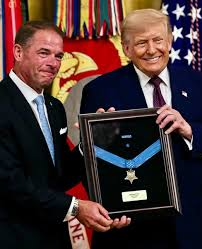
Ripley died on October 28, 2008 in Annapolis, Maryland, and was buried in the United States Naval Academy Cemetery. On Tuesday, March 3, 2026, a bill was passed through Congress authorizing his Navy Cross to be upgraded to the Medal of Honor. On Thursday, June 18, 2026, Ripley’s family received his posthumous Medal of Honor. It was presented by President Donald J. Trump to his son, Thomas.
MOH CITATION:
The President of the United States, in the name of The Congress, takes pleasure in presenting the Medal of Honor to Colonel John Ripley. For conspicuous gallantry and intrepidity at the risk of his life above and beyond the call of duty on 2 April 1972 while serving as Senior Marine Advisor to the Third Vietnamese Marine Corps Infantry Battalion in the Republic of Vietnam. Based on a report that a large and rapidly moving mechanized North Vietnamese army force was attacking south along Route #1, Third Battalion was positioned to defend the key village of Dong Ha and its surrounding area. It became clear the enemy advance could not be halted unless the bridge over the river at Dong Ha was destroyed. To personally supervise this dangerous and vital mission, Captain Ripley advanced to the bridge where he located 500 pounds of explosives that had been prepositioned there earlier, but access to it was blocked by a chain-link fence. He was forced to climb hand over hand along the steel beams of the bridge to reposition the explosives properly so the bridge could be destroyed. On five separate occasions, both physically exhausted and exposed to continual enemy fire, Captain Ripley completely disregarded his own safety as he moved to key points along the bridge and securely emplaced the explosives. He then detonated the charges and destroyed the bridge, thus thwarting the enemy’s assault. By his bold and audacious actions, extraordinary courage under fire, and complete dedication to duty, Captain Ripley reflected great credit upon himself and upheld the highest traditions of the Marine Corps and the United States Naval Service.
BURIAL LOCATION: UNITED STATES NAVAL ACADEMY CEMETERY, ANNAPOLIS, MARYLAND.
SECTION 3, LOT 346.
LOCATION OF MEDAL: FAMILY.