b. ? Arnold, Nottingham.
DATE OF CGC ACTION: 22/06/2009 Helmand Province, Afghanistan.
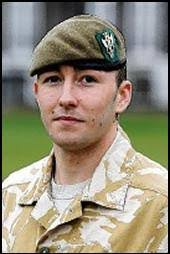
Kyle P Smith CGC
Kyle Smith enlisted with the Mercian Regiment, and was serving in 2 Mercian when he was deployed to Afghanistan in 2009. He would be awarded the Conspicuous Gallantry Cross for his actions during Operation Panchai Palang (Panther’s Claw).
Panther’s Claw was launched around midnight on 19 June 2009 with the stated aim of securing control of various canal and river crossings and establishing a lasting ISAF presence in an area described by Lt Col Richardson as “one of the main Taliban strongholds” ahead of the 2009 Afghan presidential election.
In what the Ministry of Defence described as “one of the largest air operations in modern times”, according to BBC News, more than 350 troops from The Black Watch, 3rd Battalion, Royal Regiment of Scotland (3 SCOTS),(2 Rifles) transported by twelve Chinook helicopters, deployed into Babaji, north of the provincial capital Lashkar Gah, in Helmand Province. The operation, which involved thirteen other aircraft—including Apache and UH-60 Black Hawk helicopters, Harriers, unmanned aerial vehicles, and an AC-130H Spectre gunship —involved both British and American air power, and was supported by more than 150 ground forces from the Black Watch and Royal Engineers.
Taliban fighters in the area launched multiple attacks against British forces, all of which were repelled, and 3 SCOTS secured three key crossings—the Lui Mandey Wadi crossing, the Nahr e-Burgha canal and the Shamalan canal—by 23 June. To restrict movement by Taliban forces, British troops also constructed several checkpoints to be manned by 3 SCOTS but eventually ceded to the Afghan National Police.
On the fourth day of the operation, Lance Corporal Smith would perform the action which saw him awarded the CGC.
Following an ambush by insurgents which immediately caused four casualties in his section and was rapidly followed up by heavy small arms fire, LCpl Smith coolly assessed the situation and single-handedly engaged the insurgents before administering first aid to the nearest casualty and dragging him into cover – courageously exposing himself to enemy fire over 100 yards (90 metres) or so of open ground in the process.
Having reached the safety of cover, he immediately returned to extract a second casualty, again placing himself in the line of fire, and applied a tourniquet to stop heavy bleeding before dragging him to safety.
In the third phase of Panther’s Claw, more than 700 British soldiers from the Light Dragoons and 2nd Battalion, Mercian Regiment (Worcesters and Foresters) supported by soldiers of the Danish Battle Group, launched a ground offensive, backed by fire support, against Taliban-held areas north of Lashkar Gah. The assault was timed to coincide with Operation Khanjar, or Strike of the Sword, launched on 2 July, by American forces against Taliban strongholds in the Helmand River valley.
The BBC reported that British troops had by 3 July, “taken some key towns”, but that their progress was impeded by insufficient resources. By 4 July, British forces had encountered “little resistance” —in contrast to American and Afghan forces to the south participating in Khanjar who were engaged in “fierce” fighting against the Taliban. As of 5 July, around 3,000 Task Force Helmand troops from the United Kingdom, Denmark, Estonia, and Afghan government forces were involved in Panther’s Claw, with the British MoD reporting close quarters combat with Taliban fighters.
On 5 July, Danish Daily Politiken reported that between 55-65 soldiers or nearly half the corps, of the Danish Special Forces unit Jægerkorpset had been deployed in the operation, with the primary objective to aid regulars of the Danish Army secure 13 bridges over a major irrigation canal in the area. It’s one of the largest known deployments of Danish special forces on foreign soil, and the largest since 2002.
Kyle Smith was invested with the CGC on 9 July 2010 at Buckingham Palace.
LOCATION OF MEDAL: WITH RECIPIENT.
