b. 14/05/1890 Te Kopuru, NZ. d. 29/09/1918 Peronne, France.
Lawrence Carthage Weathers (1890-1918) was born on 14th May 1890 at Te Koparu, near Dargaville, North Wairo, New Zealand. His father, John Joseph Weathers, was born in Cavan, Ireland, and married Johanna Ellen Frances McCormack, from South Australia, on 24th October 1878 at St Anthony’s Church, Manoora, South Australia. The family emigrated to New Zealand between 1880 and 1885. Lawrence’s father died when he was 9 in 1899, and Johanna returned to South Australia to be with her family. Lawrence had six siblings.
Lawrence was educated at Snowtown Public School, South Australia. He was taken on by one of his mother’s brothers, who agreed to teach him farming. However, he was used as cheap labour so moved to Germany to seek employment with his two brothers in October 1910. They were treated badly by the German crew during the voyage and ended up in England instead. He then became a builder’s labourer. He returned to Australia in 1913, became an undertaker in South Australia and was subsequently promoted foreman.
Lawrence married Annie Elizabeth Watson, a domestic servant born in Melbourne, Victoria, on 10th September 1913 at her father’s home in Unley, Adelaide. Lawrence and Annie had two sons – Kenneth and John.

Lawrence C Weathers VC
Lawrence enlisted in the AIF at Adelaide Town Hall on 3rd February 1916. He joined B Company, 2nd Depot Battalion AIF on 14th February and transferred to 17th Reinforcements, 10th Infantry at Mitcham on 1st March. He was admitted to Torrens Island Venereal Disease Camp on 12th March with gonorrhea and transferred to 10th Reinforcements, 10th Infantry on 20th April. Lawrence was admitted to Keswick Military Hospital on 21st May with influenza and transferred to No 17 Auxiliary Hospital on 29th May. He did not leave for France until 25th November.
On 18th January 1917, he was admitted to 9th Australian Field Ambulance with venereal disease. He was discharged fit for duty on 8th February to 3rd Australian Division Base Depot and rejoined his unit on 24th April. He received a gunshot wound to the left leg at Messines on 10th June and was admitted to 9th Australian Field Ambulance and No 53 Casualty Clearing Station next day.
He was promoted to lance corporal on 21st March 1918 and was gassed near Villers Bretonneux on 26th May. He was admitted to No 49 Casualty Clearing Station and rejoined his unit on 18th June.
After the capture of Mont St Quentin, the duty of clearing a small area criss-crossed with barbed wire entanglements north of Péronne fell to the 43rd Battalion on 2nd September. The major objective was Scutari trench. The unit went forward at 5.35 that morning, but was halted by scything fire. From the vanguard Weathers attacked the enemy garrison and killed its leader. Replenishing his stock of bombs, with three others he went back into the fray. Given cover by a comrade’s Lewis-gun, Weathers seemed oblivious to danger as he scaled the German parapet and hurled his bombs into the trench below. By 7 a.m. resistance ceased. He took three machine-guns and 180 prisoners back to his lines. His uniform caked in mud, with blood streaming down his face and five days stubble, Weathers looked quite a ‘card’ to his mates when he returned with souvenired German binoculars and pistols festooning him like a Christmas tree. The strain and the release of nerves showed in his chatter of how he had ‘put the wind up’ the enemy. He was recommended for the Victoria Cross.
Promoted temporary corporal on 10th September 1918 (his fifth wedding anniversary), Weathers received a short respite from action before moving with his battalion to attack the Hindenburg line between Rosnoy and Bony. At dawn on the 29th September, the engagement commenced; wounded by shell-fire, Weathers died before dusk at the 41st Battalion Regimental Aid Post. He never knew of his V.C. which was gazetted on Christmas Eve, 1918. He was originally buried on a bank near a sunken road about 1,800m northeast of Hagnicourt and 2,750m southeast of Lempire. His body was later exhumed and buried in Unicorn Cemetery, Venduille, France.
Lawrence Weathers’ Victoria Cross was presented to his widow, Annie Elizabeth Weathers, by General Sir William Birdwood in Adelaide on the 6th March 1920. He is commemorated with Weathers Barracks in Linton, New Zealand, with Weathers Place in Napier, New Zealand, with Weathers Street in Canberra, ACT, on the VC Memorial in Campbell, ACT, with Weathers Place in Wodonga, Victoria, on the War Memorial in North Terrace, Adelaide. He was also named on the VC Memorial in Sydney, on the VC Recipients Wall on North Bondi War Memorial, and with a VC commemorative stone at National Memorial Arboretum, Alrewas, Staffordshire.
In addition to the VC he was awarded the British War Medal 1914-20 and Victory Medal 1914-19. The VC was sold by the family to a private bidder at a Noble Numismatics of Sydney auction at the Dixson Room, State Library of South Australia, on 8th April 2016 for $AUS500,000. The VC was donated anonymously to the Australian War Memorial, Canberra. Since 21st October 2016, it has been displayed there.
LOCATION OF MEDAL: AUSTRALIAN WAR MEMORIAL, CANBERRA.
BURIAL PLACE: UNICORN CEMETERY, VENDUILLE, FRANCE.
PLOT III, ROW C, GRAVE 5

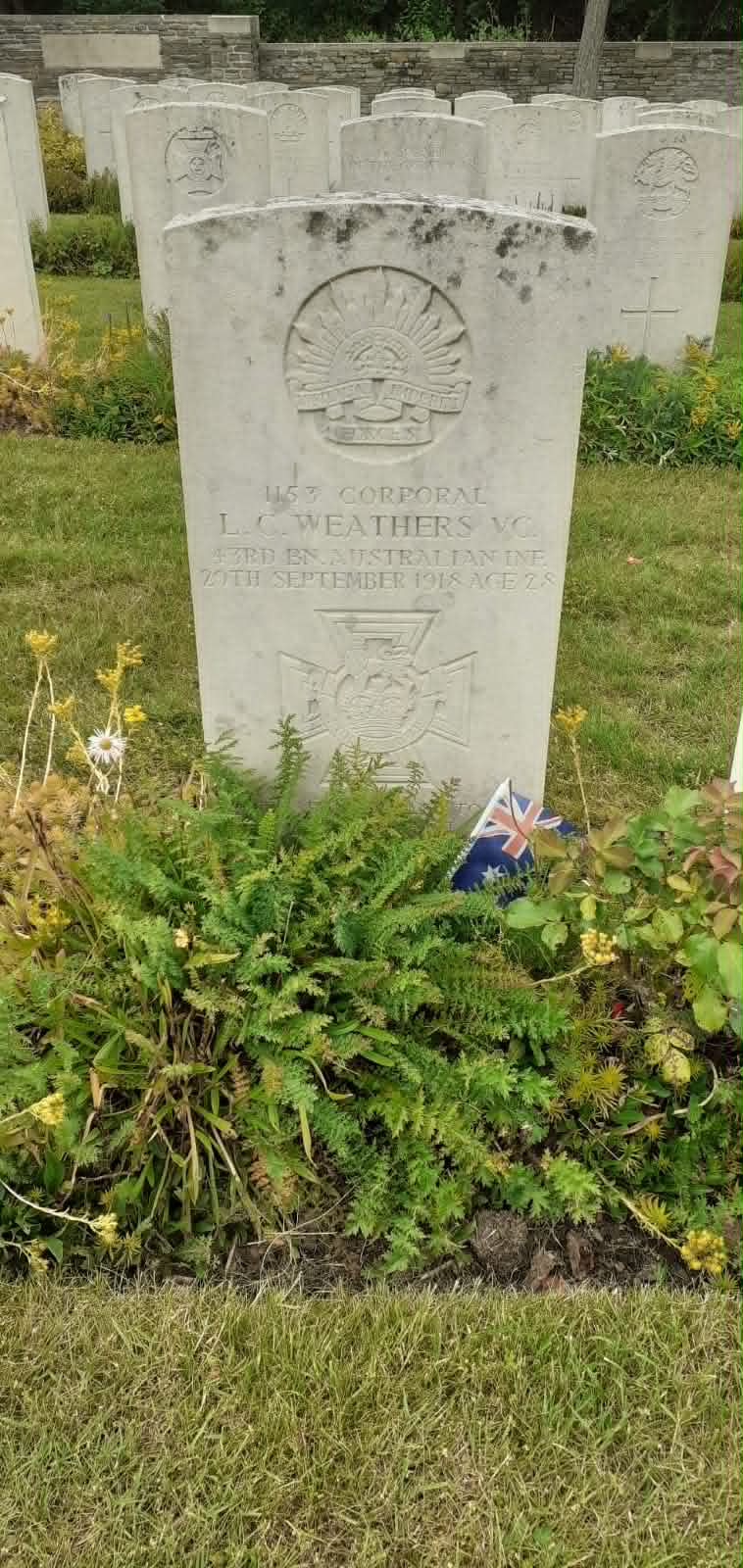


Acknowledgement:
Kevin Brazier – Cemetery Map and Grave Image.