b. 06/05/1896 Southsea, Hampshire. d. 10/01/1937 Durban, South Africa.
Robert Vaughan Gorle (1896-1937) was born on 6th May 1896 at 67 Victoria Road South, Southsea, Hampshire. His father, Major Harry Vaughan Gorle DSO, originally from Cornwall, was educated privately and joined the Royal Berkshire Regiment (Princess Charlotte of Wales’s) from 4th (Militia) Battalion, Lincolnshire Regiment on 28th June 1890. He was promoted lieutenant on 29th September 1893 and transferred to the Army Service Corps on 1st October. Harry married Ethel Catherine Archdall, who was from Queenstown, County Cork, Ireland, on 27th June 1895 at Cork, where she died in 1904, when Robert was 8. Harry was promoted to captain, and served throughout the Second Boer War, where he was awarded the DSO. He was promoted to major and retired from service on 6th June 1908. He returned to South Africa in 1914. Harry married Edith Mary Francis on 2nd June 1914 at Bridestowe, near Okehampton, Devon. Harry had two other children from his second marriage.

Robert V Gorle VC
Robert was educated at The Wells House, Malvern Wells, Worcestershire and Rugby School, Warwickshire until August 1911. He became a farmer in the Transvaal and returned to Britain on the outbreak of war.
Robert applied for a commission on 19th April 1915 and was commissioned on 15th May into 161st Brigade, Royal Field Artillery, 31st Division. Robert sailed for France on 31st December 1915. He was wounded by a gunshot in the left arm on 3rd July 1916 and was evacuated to England the next day. He was treated at 1st London General Hospital, Camberwell from 6th July. A medical board there on 31st July found him unfit for any service for two months and he was granted leave to County Cork to convalesce. On 23rd October he joined 23rd Artillery, 5th B Reserve Brigade at Ballincollig, Ireland. A medical board at the Central Military Hospital, Cork on 9th November found him fit for General Service. He was promoted to lieutenant on 1st July 1917.
On 5th October he was wounded by a shell in the right back and top of the right arm near Ypres. A fragment was removed at 5th British Red Cross Hospital, Wimereux on 10th October. It is not known when Robert transferred to 50th Brigade, Royal Field Artillery in 9th Division. However, it must have been before he was wounded because 32nd Division was not involved in the Third Battle of Ypres but 9th Division was. He was evacuated to England via Boulogne to Dover on 14th October and was treated at Prince of Wales’s Hospital for Officers, Marylebone Road, London. He was out of service for a considerable period of time, not being passed fit until 26th March 1918, and he subsequently returned to France.
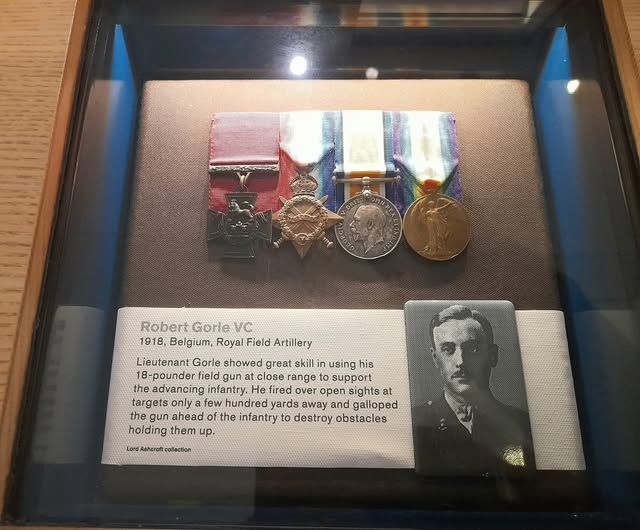
On 1st October 1918 at Ledeghem, Belgium, Lieutenant Gorle was in command of an 18-pounder gun working in close conjunction with the infantry. He brought his gun into action in the most exposed position on four separate occasions and disposed of enemy machine-guns by firing over open sights under direct fire. Later, when the infantry were driven back, he galloped his gun in front of the leading troops and twice knocked out enemy machine-guns which were causing the trouble. His disregard of personal safety was a magnificent example to the wavering line which rallied and re-took the northern end of the village.
His Victoria Cross investiture was by King George V at Buckingham Palace on 14th June 1919. He was demobilised from the Officers’ Wing, Repatriation Camp, Pirbright, Surrey and resigned his commission on 25th July 1919, retaining the rank of lieutenant.
After the war he returned to Southern Africa and farmed near Fort Jameson, Northern Rhodesia (now Zambia). He married Ruth Thomas on 9th July 1924 at Plumtree, Southern Rhodesia. Robert and Ruth would have three children. One of the sons later became the principle of the Solusi College near Bulawayo, Southern Rhodesia (now Zimbabwe) while the daughter is a doctor in East Africa. Over the period 1929 to 1937 he was the Sergeant at Arms and Librarian of the Southern Rhodesia Parliament (now Zimbabwe).
Robert died on 10th January 1937 in the Addington Hospital, Durban, Natal, South Africa and is buried in the Stellawood Cemetery in Durban. Apart from his headstone which displays the Victoria Cross he is commemorated on a plaque in the Stellawood Cemetery which was erected by the British Empire Service League (BESL), on the Royal Artillery Memorial, Woolwich, London and in the World War One corner of the Castle in Cape Town, Western Cape, South Africa. He also has Gorle Road named after him in Larkhill, Wiltshire, is named on the Royal Artillery Memorial in Woolwich, on the memorial plaque in the Royal Artillery Tercentenary Chapel at Larkhill, and with a VC commemorative stone placed at Southsea, Hampshire on 1st October 2018.
In addition to the VC, he was awarded the 1914-15 Star, British War Medal 1914-20 and Victory Medal 1914-19. There was a claim that the VC group and his father’s DSO group were passed to Joan Howson and were stolen in the 1980s. The allegation has not been verified. The VC group was owned by Kevin Patience of Bahrain between 1987-1991 and was purchased by Lord Ashcroft at a private sale in 1993.
LOCATION OF MEDAL: LORD ASHCROFT COLLECTION.
BURIAL PLACE: STELLA WOOD CEMETERY, DURBAN, SOUTH AFRICA.
SECTION K, GRAVE 144




Acknowledgement:
Derek Walker – Image of Gorle VC Grave in Stellawood Cemetery, Durban, South Africa.
Mark Sanders – Image of Gorle VC Medal Card.