b. 08/06/1919 Southport, Lancashire. d. 23/04/1943 Guiriat el Atach, Tunisia.
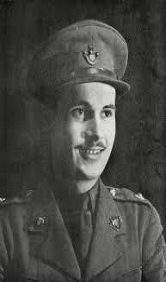
Willward A Sandys-Clarke VC
Willward Alexander Sandys-Clarke – who always went as Peter to his family, friends and comrades – was born on 8 June 1919 at Southport, Lancashire, the son of William Edward and Edith Isobel Congreve (née Sandys) Sandys-Clarke. His father was serving in the Royal Naval Air Service and the family lived at Challen Hall, Silverdale, on the North Lancashire coast. The family had a successful cotton mill business.
As so often is the way with the Victoria Cross, it seems gallantry ran through the family, for young Sandys-Clarke could count himself related to no less than four recipients. His maternal grandfather was Colonel Francis Robert Sandys, a cousin of Lord Roberts V.C. (Indian Mutiny – Khudaganj) and General Congreve V.C. (Second Boer War – Colenso), both who had sons who each followed their fathers to earn the ultimate award for gallantry. Lieutenant The Hon. Frederick Roberts took a posthumous V.C. at Colenso whilst Major Billy Congreve won a posthumous V.C. on the Somme in 1916. The bar was set rather high.
The family moved to Darwen in 1924, and young Sandys-Clarke was educated at Morland House Prep and then Uppingham from September 1933. Whilst there, he proved himself a fine sportsman, playing in the Cricket XI, Rugby XV as scrum half and fives team – also featuring in a Lords XI with bowling figures of 5-1-7-1 and 4-1-12-1 at the Home of Cricket – leaving in late 1937. Following the death of his mother, along with his father and sister, he moved to the home of his grandfather at Harwood Lodge, Turton, near Bolton.
With little enthusiasm Sandys-Clarke went to work for the family business and also joined the Territorial Army, being proudly commissioned into the 5th Battalion, The Loyal (North Lancashire) Regiment in late 1938.
With the outbreak of the Second World War, his unit was mobilised and first put onto Home Defence duties as they came to strength and were also converted as a motorcycle unit. Whilst stationed near Tunbridge Wells in September 1940, Sandys-Clarke found himself in a dreadful accident. Rushed to the Kent & Sussex hospital, he suffered severe injuries to his head and eyes which required numerous operations and a long recovery period. The young man was left with significantly impaired vision in one eye, deafness in his left ear and a total numbness on the left side of his face. Having been examined by Sir Stewart Duke-Elder, the nation’s foremost eye specialist, he was told he had ‘…a cat in hell’s chance’ of seeing active service given the severity of his injuries.
As a result, still undergoing recovery and attempting to pass the Medical Board, Sandys-Clarke was forced to wave his comrades off when the 5th Battalion was shipped out to the Far East in late 1941. Redesignated the 18th Battalion, Recce Corps, they made Singapore on 5 February 1942 and were taken Prisoners of War at the Fall of Singapore just two weeks later. They lost 55 killed in the Battle of Singapore, whilst a further 264 died as prisoners at the hands of the Japanese.
Having twice failed at the hands of the Medical Board, he kept trying in the forlorn hope of getting the opportunity to serve on the front line. On the third and final attempt, entering the Board, his heart must have stopped when faced again by Duke-Elder. “Can you feel this?” “Yes, Sir.” “Can you see that?” “Yes, Sir.” The surgeon knew very well that the answers ought, truthfully, to have been “No, Sir.” However, having looked hard at the young officer and perhaps sensing his determination and courage, Duke-Elder permitted his passing, recommending that he be rated A1 by the Board.
In the summer of 1940 he had met, through his sister, Alys, Irene Deakin, whose family lived at Dimple Hall, Egerton, near Bolton. They were married on 12 July 1941, by which time Irene was serving as a Driver in the First Aid Nursing Yeomanry.
Returned to duty in early 1942, he joined the 1st Battalion, The Loyal Regiment which had been on Home Defence duties since having shared in the rearguard fighting at Dunkirk. They embarked at Liverpool in March 1943, to join the 1st Army in North Africa, as a part of the 78th Battleaxe Division. A fellow officer in the Battalion was Lieutenant Edward Deakin, his friend and now also his brother-in-law. He left England knowing that his wife was carrying their first child, due to be born in but a few weeks.
Landed at Algiers by 9 March, they were taken along the coast by LCI to Bougie and thence Bone. Disembarked, they marched for Medjez-el-Bab and came up to their lines. Settling down to their duties, they were tasked with the removal of enemy mines, placing new counter-mines when possible and patrolling.
A vast German attack was launched onto their positions on 20 April from around 2200hrs into the Tunisian night. A battle of some twelve hours played out, with Allied tanks coming up through The Loyals, with Sandys-Clarke and his ‘B’ Company in the thick of events. They held their high ground in the west admirably – in what be the first of several hot contacts with their Afrika Korps enemies in the coming days.
On what was both St. George’s Day and Good Friday, 23 April 1943, Sandys-Clarke and the 1st Battalion, The Loyals, with the 2nd Battalion, North Staffordshire Regiment on their right, were charged to take Gueriat-el-Atach. This was the formidable feature of high ground some five miles from Medjez-el-Bab. It was made up of no less than eight known Points for capture, together with a number of lesser positions. It stood as one of the strongest points in the line of German defences on the route to Tunis and was a key proponent of Operation Vulcan.
Commenced at 0200hrs, a creeping barrage and smoke shells helped in infantry – who made up the point of the spear – forward. By 0400hrs, ‘B’ Company were making good ground and had 16 prisoners for the bag at the cost of one killed and six wounded. The other Companies had not made such light work of things, ‘A’ Company being pinned down in the face of a strongpoint. Forward Battalion HQ found themselves in a minefield, which cost the lives of the C.O., Lieutenant-Colonel Gibson and Major Coles, both mortally wounded.
As the British artillery fell quiet, the German artillery came to the party with great effect, together with an infantry counter. ‘B’ Company found itself faced with six armoured cars attempting to come up to their Point to drive them off. Command of ‘B’ Company devolved upon Sandys-Clarke when Captain Grant was killed. He answered the call of duty in the finest style, bringing up assistance with Churchill tanks. The determined band who remained on the hill (Point 174) inflicted as many casualties as they might on the enemy before being themselves being driver off. They pulled back to the Forward Battalion HQ, or all that remained of it, where Sandys-Clarke found himself the only officer standing from those who had gone to the hill that morning.
He was wounded himself, his glasses being shattered and blood pouring from his wounds. Convinced of the fact that he could retake the objective and drive the enemy off Gueriat-el-Atach, Sandys-Clarke was granted permission to form a composite Platoon. It was a truly selfless act from a soldier who had so many genuine reasons and opportunities to fall back in honour, from his damaged eye, which would have stopped most from even entering the field of battle, to the wounds which he had suffered, which must surely have further debilitated him. It was in this moment of resolution that Sandys-Clarke embodied the fact that those who earn a Victoria Cross are of a unique breed.
The acts which are stated in the citation are the stuff of legend and were observed by many comrades, including his brother-in-law, who wished him luck and watched the band make their way across the battle-scarred Tunisian ground. Irene’s mother, Dorothy Deakin, would receive the official telegram of his death dated 28 April 1943. She would have to keep the secret from her daugter for a full week until her baby had been born and both mother and child were considered safe. She visited the nursing home daily, being forced to hold back the news which would shatter her plans for a future which was to be torn apart. Irene and Peter’s son, Robin Peter, would be born on 1 May 1943, eight days after the death of his gallant father.
Sandys-Clarke was buried in the Massicault War Cemetery, his gravestone bearing the Regimental motto LOYAUTÉ M’OBLIGE (Loyalty Binds Me). With final approval of the award of his Victoria Cross being published in June 1943, Mrs Sandys-Clarke went to Buckingham Palace with her sister-in-law Alys, to receive the award from the hands of The King on 14 June 1944. On 26 June 1956, on the 99th Anniversary of the first award of the V.C. by Queen Victoria at Hyde Park, that his thirteen year old son would go with his grandfather to share in the Victoria Cross march-past before Queen Elizabeth II. Some three hundred holders and their families, with over 20,000 spectators turned out for the historic event.
Sandys-Clarke is further commemorated upon the family gravestone at Bollington Church, Lymm, where a lectern in his honour was presented; in Preston, the home of The Loyals; at Uppingham School; in a painting at The Lancashire Infantry Museum and at Southport, where a paving stone in the park commemorates the five holders of the Victoria Cross from the town.
His family chose to auction his Victoria Cross medal group at Spink and Son on Thursday 24 July 2025. The hammer price realised on the group was £350,000. The purchaser was Lord Ashcroft.
LOCATION OF MEDAL: LORD ASHCROFT COLLECTION.
BURIAL PLACE: MASSICAULT WAR CEMETERY, MANOUBA, TUNISIA.
PLOT V, ROW B, GRAVE 1.
SPINKS – Images of the medal group.


